

















Introduction
Third parties are now deeply embedded in how modern organisations operate. SaaS platforms, cloud providers, payroll vendors, software companies, consultants, data processors, and outsourced service providers may all have access to important systems, sensitive information, or critical business processes.
This creates a simple yet pressing challenge: a vendor can appear completely secure on paper while still introducing significant risk to the organisation.
That is why Third-Party Risk Management (TPRM) needs to move decisively beyond static questionnaires and document collection. Its real purpose is to understand the risk created by a third-party relationship, determine whether existing controls are genuinely effective, and decide whether the remaining risk is acceptable.
Identify the real exposure created by access, data sensitivity, and operational dependencies.
Validate whether safeguards are active and functioning, rather than merely collecting certificates.
Determine if remaining residual risk is acceptable or requires targeted corrective action.
Why Third-Party Risk Matters
A third party may have direct access to sensitive company records, confidential customer or employee data, business applications, critical infrastructure, or processes that the organisation relies on daily.
Because of this interconnectedness, a weakness at that provider can immediately become a vulnerability for the organisation itself. Regulatory bodies across banking, fintech, and enterprise sectors increasingly treat vendor security posture as an extension of internal governance.
The level of risk is also fundamentally different for every relationship. A supplier delivering low-impact office equipment should not be assessed through the same lens as a cloud provider hosting sensitive customer financial data or a third-party payroll vendor processing employee salaries and identification numbers.
A stronger TPRM programme therefore begins by establishing clarity across four core dimensions:
Service Provided
The exact scope, operational criticality, and business function fulfilled by the vendor relationship.
Data Handled
The volume, sensitivity, regulatory classification, and residency of all data stored, processed, or transmitted.
System Access
Network perimeters, API integrations, credential privilege tiers, and direct remote environment access.
Business Dependency
The operational downtime, financial liability, and substitution difficulty if the vendor suffers service failure.
Moving Beyond the Questionnaire
Traditional vendor assessments often follow a familiar checklist routine:
The Problem: Completing an assessment does not automatically mean the underlying risk has been understood, internalized, or mitigated.
The Outcome: Translates security evidence and operational exposure into clear, defensible executive action.
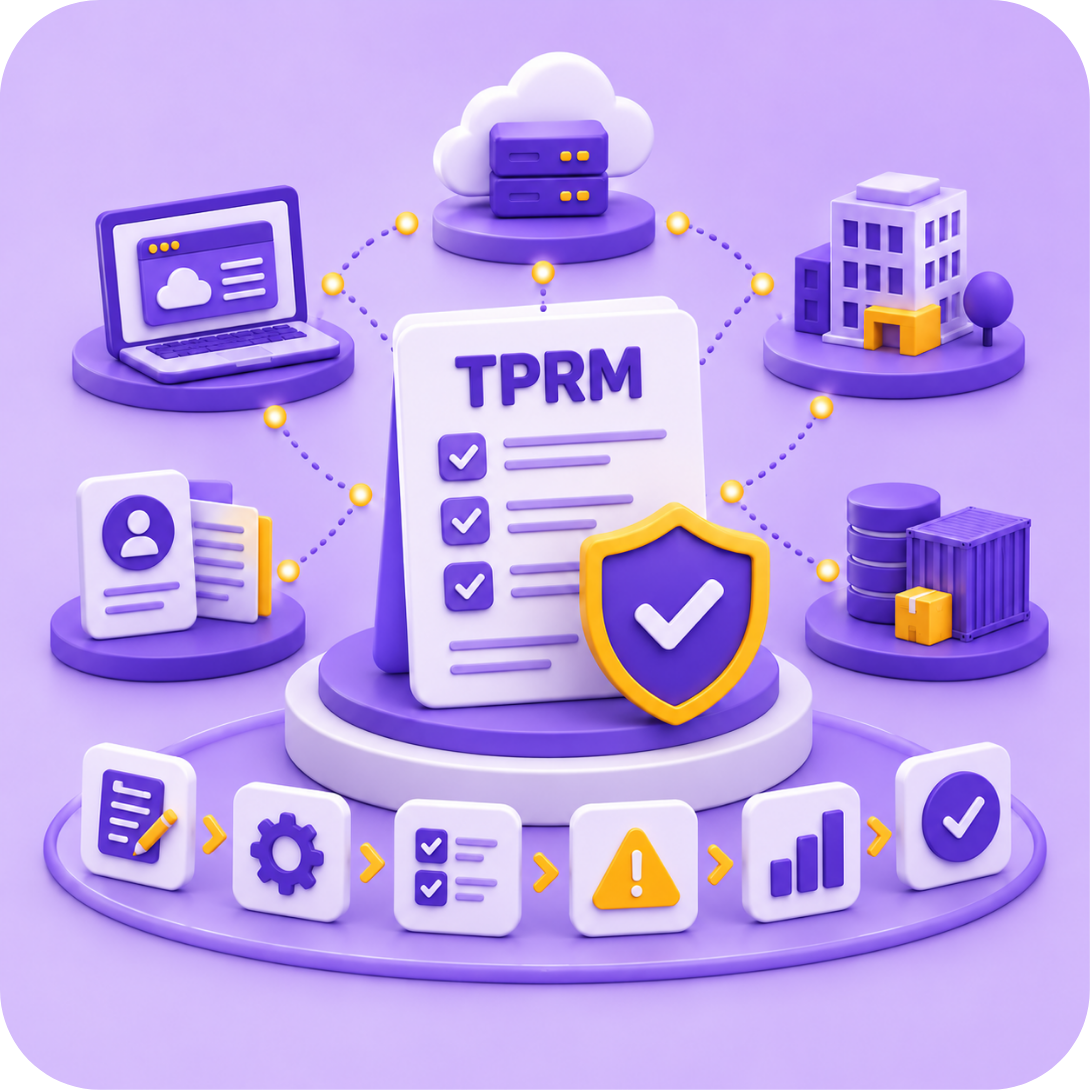
To achieve true risk resilience, a mature Third-Party Risk Management process must progress systematically through six structured stages:
- 1
Profile the Third Party
Establish comprehensive visibility into the service provided, data handled, internal networks accessed, and overall operational importance to the business.
- 2
Evaluate the Level of Exposure
Calculate the exposure created by the engagement, taking into account data confidentiality, system interconnectivity, operational criticality, and regulatory compliance obligations.
- 3
Verify Safeguards & Controls
Validate whether expected security controls, encryption protocols, and governance guardrails are actively in place and functioning effectively as intended.
- 4
Address Weaknesses & Gaps
Remediate identified security deficiencies by assigning clear internal ownership, mandatory corrective action plans, and contractual completion deadlines.
- 5
Track Ongoing Relationship Changes
Monitor changes in the vendor relationship, control environment, infrastructure updates, and risk profile over time rather than relying on annual audits.
- 6
Determine Residual Risk Acceptance
Empower risk committees and executives to determine whether the remaining residual exposure is acceptable or requires further escalation, risk transfer, or contract termination.
Evidence Needs to Prove the Control
Evidence plays an indispensable role in any credible third-party assessment. Organisations regularly review compliance artifacts such as:
• SOC 2 Type II Reports and independent service auditor evaluations
• ISO 27001 / ISO 27701 certifications and Statements of Applicability (SoA)
• External Penetration Testing results, vulnerability scans, and remediation proof
• Information Security Policies, Business Continuity Plans (BCP), and Disaster Recovery (DR) test logs
• Access-Control Evidence, including Multi-Factor Authentication (MFA) enforcement and privileged account audits
However, simply receiving a document should never complete an assessment. Having a policy file on record does not guarantee that safeguards are actively enforced within the vendor’s production environment.
Real-World Scenario: The Payroll Service Provider
Consider a third-party payroll provider processing highly sensitive employee personal identification numbers, banking details, and compensation data. Receiving a generic security certification only confirms that an audit took place within a specific scope. True risk management requires verifying whether their controls directly protect your employee records, whether customer data is segregated, whether encryption keys are isolated, and how access logs are monitored against insider compromise.
Third-Party Risk Does Not Stop After Onboarding
A vendor’s risk posture is never static. Risk inherently evolves over the course of a business relationship.
A vendor may alter its underlying technical infrastructure, retire key security controls, allow an ISO certification to lapse, experience a security incident, or gradually expand its access to your internal networks. Furthermore, outstanding remediation from past audits can quietly become overdue, while dependencies on the vendor—and on the vendor's own third parties (fourth parties)—continue to deepen.
Periodic annual assessments remain useful, but they offer only a single point-in-time snapshot. Continuous visibility enables organisations to detect critical posture changes before the next scheduled review.
5 Critical Pillars of Continuous Vendor Monitoring
1. Security Incidents & Control Shifts
Instant detection when a provider suffers a breach, alters its perimeter defenses, or encounters critical service interruptions.
2. Certifications & Supporting Evidence
Automated tracking of certificate expiration dates, SOC 2 audit period coverage, and renewal validation.
3. Outstanding Remediation
Real-time tracking of open audit findings, security remediation commitments, and contractual SLA compliance.
4. Access & Criticality Creep
Monitoring when an engagement expands into additional business units or gains elevated system authorizations.
5. Fourth-Party Dependencies
Uncovering risks rooted deep within your vendor's own outsourced supply chain and sub-processors (e.g., outsourced data hosting, offshore contractors, sub-service organisations).
Strengthening TPRM with Kollect*AI GRiC
This is where Kollect*AI GRiC delivers a connected, intelligent approach to modern third-party governance.
Today, many organisations still juggle vendor records, contract addendums, risk assessments, and remediation tracking across scattered spreadsheets, disconnected emails, and shared folders. Kollect*AI GRiC brings these disparate governance and risk sources into an authoritative, common system of record, supporting continuous monitoring across vendors, contracts, and operational data.
Unified Governance Without Headcount Expansion
Kollect*AI GRiC provides standardized risk scoring and automated governance workflows across TPRM, operational risk, and regulatory compliance—while maintaining human-in-the-loop approval for critical risk determinations.
Centralizes vendor tiers, contracts, evidence repositories, and risk evaluations into a single source of truth.
Monitors vendor status and contractual SLAs continuously rather than waiting for annual review cycles.
Aligns TPRM scoring with your wider enterprise risk framework and compliance mandates.
Every assessment action, control review, and approval is logged and timestamped as it occurs, ready for regulatory review.
By recording actions, timestamps, and ownership attribution in real time, GRiC establishes a permanent audit trail, eliminating the need to frantically reconstruct compliance evidence when auditors or regulators arrive.
Final Thought: TPRM Is About the Decision
A successful third-party risk assessment should never conclude with a hollow administrative question:
“Did the vendor complete the questionnaire?”
Instead, it must conclude with strategic clarity:
• Do we understand the specific operational and data risk this relationship introduces?
• Are the vendor's safeguards actively verified and provably effective?
• What remediation gaps remain, and who is accountable for closing them?
• Is the organisation prepared to accept the remaining residual risk?
“The strongest TPRM programmes do not simply collect vendor information. They turn vendor information, security controls, and evidence into informed risk decisions.”
Elevate Your Third-Party Risk Management
See how Kollect*AI GRiC unifies vendor assessments, continuous monitoring, and audit trails.