Last Updated: October 2026• 7 min read• Kollect*AI GRiC
Kollect*AI GRiC
Enterprise GRC Operating Model
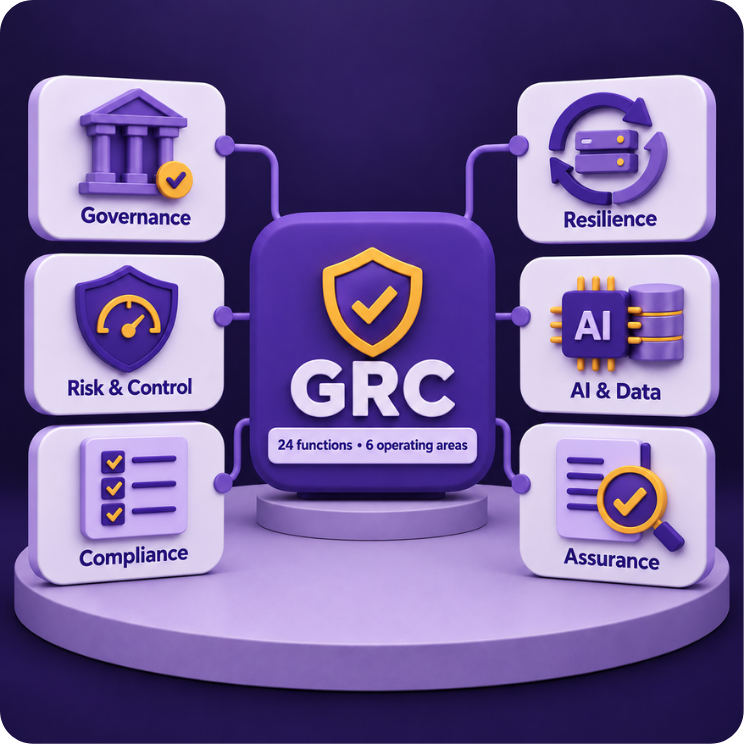
24 Functions • 6 Connected Operating Areas
Introduction
Enterprise Governance, Risk and Compliance (GRC) establishes a common operating structure for regulatory policy alignment, risk assessment, control ownership and assurance.
This structure maintains traceable relationships among regulatory obligations, risk scenarios, control objectives, evidentiary artefacts and remediation activities, providing management with a consistent, defensible basis for risk decisions.
Kollect's GRC operating model comprises 24 functions across six operating areas: Governance, Risk and Control, Compliance, Resilience, AI and Data, and Assurance. These functions connect decision rights and risk appetite with control execution, operational resilience and independent assurance. Their collective purpose is to maintain visibility over control effectiveness, unresolved deficiencies and residual exposure across the entire enterprise.
Traceability
Map regulatory mandates directly to control architecture, testing evidence, and active deficiencies.
Ownership
Establish structured accountability across executive forums, risk custodians, and remediation owners.
Assurance
Unify continuous monitoring, independent audit, and risk indicators into defensible board decisioning.
Area 01 • 4 Functions
Governance Areas
Governance defines organisational direction, accountable ownership, decision rights and risk boundaries across the enterprise control environment.
Policy Framework
Establishes the enterprise policies and standards governing control design and operational discipline.
Governance Accountability
Assigns board, executive and management responsibility for risk acceptance, control performance and compliance oversight, establishing structured control ownership.
Risk Appetite
Specifies approved tolerance levels, escalation thresholds and enterprise decision boundaries governing risk trade-offs and out-of-tolerance exposure.
Executive Oversight
Provides formal governance forums for challenging risk assessments, reviewing control exceptions and monitoring remediation commitments.
Operating Imperative: Material exposure must be escalated to designated authorities with substantiated control evidence and outstanding remediation status, establishing a defensible basis for risk acceptance.
Area 02 • 4 Functions
Risk and Control Areas
Risk and control management establishes continuous traceability from risk identification through control verification, remediation and residual-risk assessment.
Risk Sensing
Identifies changes in strategic, operational, cyber, third-party and regulatory exposure across the enterprise risk profile.
Control Architecture
Maps preventive and detective controls to risk scenarios, critical business processes and material obligations, linking each control objective to its intended exposure.
Control Testing
Verifies operating effectiveness against relevant control objectives, supported by evidentiary artefacts that demonstrate consistent, repeated control execution.
Action Remediation
Records control deficiencies and assessment findings, assigns remediation owners and completion timelines, and retains evidence supporting closure.
Operating Imperative: Control effectiveness and outstanding remediation form the basis for evaluating residual exposure. Unresolved deficiencies must remain visible in risk assessments so management can judge acceptability within tolerance.
Area 03 • 4 Functions
Compliance Areas
Compliance establishes regulatory policy alignment by translating external obligations and internal commitments into control requirements, accountable ownership and demonstrable evidence.
Obligation Mapping
Links applicable laws, regulations, standards and internal commitments directly to control requirements.
Policy Attestation
Records periodic staff acknowledgement of policy obligations, assigned responsibilities and required conduct. Attestation evidences acknowledgement; testing substantiates effectiveness.
Regulatory Change
Monitors new requirements, consultations and implementation deadlines to assess their impact on operational processes, control design and regulatory reporting.
Compliance Cases
Structures the management of breaches, complaints, investigations and reportable events, maintaining visibility over case status and required follow-through.
Operating Imperative: A regulatory amendment may necessitate policy revision, control modification, renewed attestation, and updated supporting evidence. Complete traceability enables the organisation to demonstrate its compliance response to regulators.
Area 04 • 4 Functions
Resilience Areas
Operational resilience connects critical-service continuity, third-party dependencies, incident response and recovery validation within the governance structure.
Continuity Planning
Establishes business continuity arrangements for disruption response, service restoration and critical dependency failure.
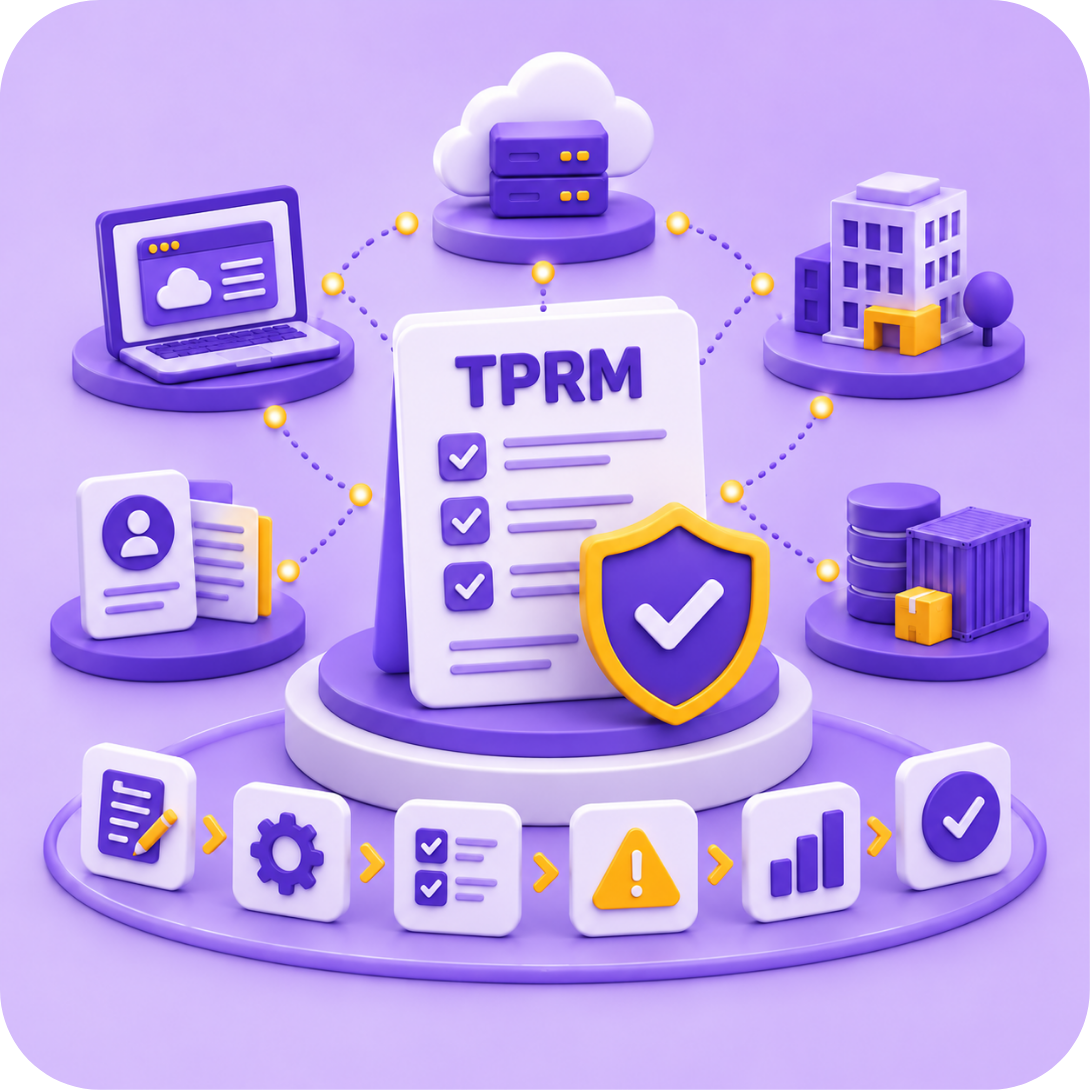
Third-Party Risk
Applies due diligence and ongoing oversight to vendors, outsourcers, cloud services and partners—evaluating criticality, data sensitivity, system access, and provider controls.
Incident Management
Coordinates operational and cyber incident triage, escalation, containment, and stakeholder communication.
Resilience Testing
Validates recovery readiness through scenario exercises, tabletop drills and recovery testing, generating evidence of whether response arrangements function as intended.
Operating Imperative: Critical-service dependencies must remain traceable across continuity plans, third-party assessments and incident records. A provider outage must automatically update control assessments, remediation workflows and executive reporting.
Area 05 • 4 Functions
AI and Data Areas
AI and data oversight establishes the control framework for approved AI use, model reliability, data lineage and personal-data safeguards.
AI Governance
Defines approved use, accountable ownership, human oversight and responsible deployment decisions.
Model Risk
Evaluates accuracy, bias, drift, explainability and use limits across analytical and AI models to ensure performance remains within authorized boundaries.
Data Governance
Maintains controls over data quality, lineage, retention, access permissions and lawful use across internal repositories and external pipelines.
Privacy Compliance
Governs personal-data handling, consent frameworks, cross-border transfers, retention limits and data subject rights management.
Operating Imperative: Data lineage establishes traceability of the information supporting an AI-enabled process, while AI governance preserves accountability for model outputs and subsequent decisions, retaining human-in-the-loop approval.
Area 06 • 4 Functions
Assurance Areas
Assurance consolidates risk intelligence, control evidence and independent evaluation to support informed and defensible management decisions.
Risk Indicators (KRIs)
Measure exposure movement, control health and emerging concentration risk against approved appetite and escalation thresholds.
Executive Reporting
Consolidates risk status, incidents, regulatory obligations and remediation progress into a consistent enterprise exposure view for board intervention.
Independent Assurance
Objectively evaluates governance design, control maturity, evidentiary quality and process reliability independent of operational teams.
Continuous Monitoring
Automates the tracking of control signals, exceptions, threshold breaches and emerging risk indicators between scheduled audits.
Operating Imperative: Monitoring signals inform ongoing risk and control assessment, while executive reporting synthesizes findings with open remediation to empower timely management intervention.
Connecting the Operating Areas
A material incident can generate interdependent risk assessments, control findings and reporting obligations across all six operating areas.
Consider a real-world scenario: a critical cloud provider experiencing a major service outage while an identified control deficiency remains unresolved. Notice how this single event activates the entire GRC operating model:
Cross-Area Incident Cascade Walkthrough
1
Resilience Activation
Third-Party Risk establishes the operational dependency profile; Incident Management coordinates triage and escalation; and Continuity Planning activates immediate service-restoration playbooks.
2
Control Testing & Remediation
Control Testing evaluates the failed safeguards and evidence records, while Action Remediation assigns corrective-action ownership, binding completion timelines, and required closure artefacts.
3
Compliance & Legal Obligations
Compliance assesses obligation breaches and regulatory disclosure deadlines. Compliance Cases structures the formal breach investigation and required external notifications.
4
AI and Data Impact Assessment
AI and Data oversight assesses affected information controls, data lineage integrity, and downstream model dependencies where services process customer data or run automated decisions.
5
Assurance & Executive Oversight
Risk Indicators and Executive Reporting communicate the revised exposure against approved appetite. Executive Oversight determines the formal risk response, while Independent Assurance validates the evidentiary adequacy of that decision.
Because the incident, affected dependencies, control findings and remediation records remain traceable across these functions, each accountable owner shares a single, synchronized view of exposure—preserving a rock-solid audit trail supporting management decisions.
Supporting the Model with Kollect*AI GRiC
Operating 24 interconnected functions across disconnected spreadsheets, emails, and shared folders is the primary reason enterprise GRC programmes break down during audits and crisis events.
Kollect*AI GRiC provides an integrated governance, risk and compliance environment that connects regulatory obligations, risk scenarios, control objectives, third-party dependencies, evidentiary artefacts and remediation activities within a common system of record.
System of Record Infrastructure
Unified Governance Infrastructure for Modern Enterprises
Kollect*AI GRiC orchestrates control workflows, aligns cross-functional risk scoring, and automates audit trail capture—while keeping human accountability at the center of critical decisions.
Common System of Record
Centralises obligations, controls, vendor tiers, and testing evidence into a single authoritative repository.
Data Lineage & Orchestration
Automated status monitoring and workflow orchestration ensure structured control ownership and consistent reporting.
Standardised Scoring Models
Connects third-party risk management with operational risk and compliance through unified scoring methodologies.
Immutable Audit Trail
Timestamped actions, versioning, and user attribution provide end-to-end auditability ready for regulator review.
Regulatory interpretation, professional judgement and management accountability remain with the responsible decision-makers. Kollect*AI GRiC provides the architectural backbone that makes that governance demonstrable.
Final Thought: Demonstrable Governance in Practice
Across all six operating areas, true enterprise maturity is not measured by the thickness of policy binders or the quantity of collected documents.
It is measured by whether an organisation maintains:
• Defined decision rights and structured control ownership across management
• Verified control effectiveness substantiated by evidentiary artefacts
• Traceable regulatory obligations updated continuously as rules evolve
• Validated recovery arrangements tested under realistic disruption scenarios
• Accountable AI and data use backed by lineage tracking and model safeguards
• Independent assurance linked directly to decisive management action
“Demonstrable governance is built when decision rights, verified control effectiveness, traceable obligations, and continuous assurance connect seamlessly into management action.”
Kollect*AI GRiC Operating Principle
Elevate Your Enterprise GRC Operating Model
Discover how Kollect*AI GRiC unifies your 24 functions into one defensible system of record.