

















Introduction: Connecting Records to Reality
A risk register can identify an exposure without showing whether the controls addressing it are effective. A policy can define an approval requirement without demonstrating that the approval occurred. An audit report can record a finding while the underlying weakness remains unresolved.
Enterprise Governance, Risk and Compliance (GRC) needs to connect these records to the decisions and activities they govern.
That requires traceable relationships between business objectives, regulatory obligations, risk scenarios, controls, accountable owners, test results and remediation. Management should be able to follow a material exposure from its source through to the evidence supporting its treatment or acceptance.
Connecting business objectives directly to operational obligations, active controls, and remediation.
Distinguishing paper compliance policies from verified, operating safeguard execution across populations.
Empowering boards and executive committees to make authorized, defensible risk acceptance determinations.
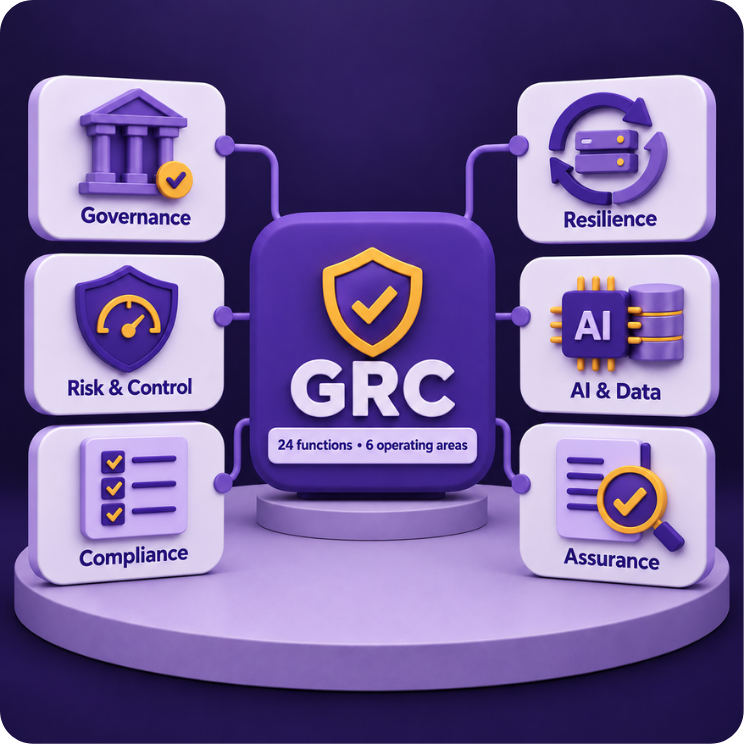
The modern enterprise operating model spans six deeply connected operating areas:
1. Governance and Leadership
Establish who can decide, who must act, and where risk acceptance authority begins and ends.
2. Risk and Controls
Connect exposures to verifiable safeguards, distinguishing inherent risk from residual reality.
3. Intelligence and Insights
Turn live operational data, KRIs, and control metrics into decision-ready risk signals.
4. Security, Resilience & Continuity
Protect critical business services, mapping technological dependencies to customer disruption limits.
5. Assurance and Validation
Establish whether evidence supports conclusions through rigorous testing and full-population checks.
6. Compliance and Obligations
Translate regulatory provisions and contracts into operational policies, owners, and workflows.
1. Governance and Leadership Establish Who Can Decide and Who Must Act
Governance begins with defined decision rights. The board approves strategic direction and risk appetite. Management translates that direction into operating limits, control responsibilities and escalation procedures. Business owners manage the risks arising from their activities, risk and compliance functions provide oversight and challenge, and internal audit provides independent assurance.
These responsibilities need to be reflected in actual workflows. A risk acceptance record, for example, should identify the exposure, affected business service, residual risk assessment, approving authority, acceptance rationale, compensating controls and review or expiry date. An exposure exceeding delegated authority should follow a defined escalation route.
Workflows in Practice: The Anatomy of a Defensible Risk Acceptance Record
A risk acceptance is not an informal memo or verbal waiver. To hold up under regulatory examination, every acceptance record must structurally capture:
• Identified Exposure: The specific cause, scenario, and technical deficiency.
• Affected Business Service: Transactions, operational functions, and customer groups impacted.
• Residual Risk Assessment: Quantified or scored severity after factoring in temporary safeguards.
• Approving Authority: The executive individual or committee empowered within the delegation matrix.
• Compensating Controls: Mandatory secondary guardrails instituted during the exception window.
• Mandatory Expiry Date: A fixed calendar sunset requiring re-evaluation or complete remediation.
Strategy, risk and performance also need to be assessed together. Introducing a new digital service may improve transaction capacity while increasing dependence on a cloud provider. The approval should therefore consider expected performance alongside service availability requirements, data-processing exposure, supplier concentration and recovery capability.
Board reporting should show material limit breaches, deteriorating controls, overdue corrective actions and decisions requiring approval. Stakeholder reporting should distinguish verified results from unresolved findings and explicitly accepted exceptions. This makes accountability visible beyond the organisation chart.
2. Risk and Controls Connect Exposure to Verifiable Safeguards
A useful risk assessment describes the cause, event and consequence of an exposure. “Cyber risk” is far too broad to determine a control response. “Compromised privileged credentials permit unauthorised changes to payment instructions” identifies an event that can be systematically assessed, monitored, and tested.
The assessment should distinguish inherent exposure from residual exposure after considering control design and operating effectiveness. Risk appetite then provides the basis for deciding whether that remaining exposure is acceptable. Operational limits and escalation thresholds translate the approved appetite into conditions that teams can monitor.
Each control record should identify its objective, owner, scope, execution frequency, procedure, required evidence and exception-handling process. For privileged access, this could include approval before access is granted, restrictions on administrative permissions, periodic recertification and review of privileged activity.
Design effectiveness asks whether those safeguards adequately address the risk. Operating effectiveness asks whether they were performed correctly across the relevant systems, users and assessment period. A documented access-review procedure alone cannot answer the second question.
Purpose, ethics and culture also require operational controls. Conflict-of-interest declarations, gift and hospitality approvals, segregation of duties and restrictions on management overrides should have identifiable owners, review records and escalation criteria. Repeated exceptions or overrides should inform the assessment of control effectiveness and conduct risk.
3. Intelligence and Insights Turn Operational Data into Risk Decisions
GRC analytics depend on consistent definitions and traceable source data. Risks, controls, obligations, vendors and business services need stable identifiers so that records from different systems can be connected without losing ownership or context.
Key Risk Indicators (KRIs)
Measure the exposure being faced. Specify calculation methods, data sources, frequency, and escalation thresholds—such as the percentage of critical services dependent on a single cloud vendor or overdue patch exposures.
Control Indicators (KCIs)
Measure the performance of safeguards. Track privileged access reviews completed within policy timeframes, failed reconciliation checks, or disaster recovery simulation test deviations.
Continuous controls monitoring (CCM) should evaluate defined conditions at a frequency appropriate to the control and available data. Missing feeds, stale records and incomplete populations must be visible; an apparently healthy dashboard is unreliable if the underlying data has stopped updating.
AI Governance: Traceability & Human-in-the-Loop Oversight
When artificial intelligence is introduced into GRC—such as proposing contract-to-policy mappings or classifying compliance risks—governance mandates strict transparency. Reviewers must always be able to inspect the source text passage, the applicable regulatory rule, the configuration version, and the model's confidence logic. Crucially, every approval, rejection, and manual override must be attributed with the responsible user and justification.
4. Security, Resilience and Continuity Protect Specific Business Services
Security and resilience assessments need to start with the business service being protected.
A critical payment service, for example, may depend on applications, databases, identity services, network connectivity, operational staff and external processors. Mapping those dependencies allows a technical failure to be assessed in terms of interrupted transactions, customer impact, data exposure and recovery constraints.
Cyber & Privacy
Connecting data classification to safeguards: access tiers, encryption, retention, and supplier processing locations.
RTO & RPO Objectives
Testing targeted restoration times (RTO) and data loss points (RPO) against approved disruption tolerances.
Incident Command
Explicit severity classification, escalation authority, communication responsibilities, and immutable decision logs.
Crisis and incident governance adds severity classification, incident command, escalation authority, communication responsibilities and decision logs. Fraud, bribery and misconduct controls require similarly explicit procedures, including transaction approval checks, supplier due diligence, investigation escalation and preservation of evidence.
Restoring a system closes only part of an incident. Root-cause findings, control weaknesses and corrective actions must remain connected to the affected service until remediation has been verified.
5. Assurance and Validation Establish Whether Evidence Supports the Conclusion
Assurance should demonstrate whether material controls work across the required scope and period.
An assurance map links significant risks and controls to management monitoring (1st Line), risk or compliance reviews (2nd Line), and independent audit coverage (3rd Line). It helps identify controls receiving repeated attention while other material exposures remain untested.
Testing should specify the population, assessment period, sampling or full-population method, expected result and treatment of exceptions. For an access-removal control, the tester would compare personnel departure records with account-disablement timestamps and investigate accounts that remained active beyond the organisation’s approved limit.
Evidence Capture vs. Control Validation: A Crucial Distinction
Automated evidence collection can preserve source records, timestamps, record identifiers and workflow history. However, evidence capture and control validation are completely separate activities. A system log showing that a supervisory review was submitted does not establish that the reviewer examined the complete user population or resolved identified exceptions. True assurance validates the integrity of the review itself.
Scenario and stress testing should challenge assumptions about simultaneous failures, prolonged outages, unavailable personnel and supplier disruption. Third-party assurance should also examine report scope, assessment periods, exclusions, subcontractor dependencies and responsibilities retained by the organisation.
Findings should move systematically through assigned ownership, corrective action, implementation evidence and retesting. Closure should reflect verified remediation or formally authorised risk acceptance, with any remaining exposure recorded.
6. Compliance and Obligations Translate Requirements into Operational Responsibilities
Compliance starts with identifying which obligations apply to a legal entity, service, processing activity or third-party relationship.
An obligations register should retain the authoritative source, relevant provision, applicability rationale, effective date, accountable owner and links to implementing policies and controls. This allows a regulatory requirement to be traced directly to the procedure implementing it and the operational evidence demonstrating performance.
Policy Lifecycle Governance
Governing drafting, review, approvals, version control, publication, acknowledgment, and mandatory change impact assessments.
Speak-Up & Investigations
Restricted access, conflict-of-interest checks, evidence vaults, escalation duties, and feedback into risk registers.
Business continuity readiness belongs in this structure wherever obligations or contractual commitments require recovery arrangements and testing. The compliance record should connect those requirements to approved plans, exercise results and outstanding corrective actions.
Compliance-system effectiveness can then be assessed through missed obligations, repeat breaches, overdue implementation actions and failed controls. Emerging-risk sensing should also capture developments such as new service dependencies, changes in technology use and recurring incidents that may require revised policies or additional controls.
When Something Fails: The Connections Become Visible
Consider a real-world scenario: a critical third-party service provider conducts a recovery exercise that exceeds the organisation's approved recovery objective.
In a disconnected organization, this result sits in a vendor manager's inbox. In an Enterprise GRC operating model, the result triggers an unbroken chain of connected actions:
Vendor recovery exercise exceeds recovery time objective (RTO); evidence recorded.
Control owner documents recovery safeguard failure and flags associated provider record.
Operational risk posture updates automatically on all dependent business services.
Compliance evaluates customer contractual commitments and regulatory notification rules.
Action plan assigns owner, remediation milestones, retesting date, and compensating controls.
Authorized decision-maker determines if temporary exposure can be accepted under delegation limits.
Assurance independently validates retest evidence before formally closing the exposure.
Management reporting immediately reflects the affected service, outstanding exposure, and approval status. Each function contributes to the same unified decision using evidence that remains traceable across the entire process.
Supporting Enterprise GRC with Kollect*AI GRiC
Kollect*AI GRiC brings Governance, Risk, Intelligence and Compliance into a common operating environment.
Its unified architecture eliminates fragmented silos, combining four core technical layers:
Standardized Scoring & Governance Without Headcount Expansion
Kollect*AI GRiC provides standardized workflows across TPRM, operational risk, and regulatory compliance—pairing high-speed intelligent analysis with strict human-approval gates for decisions requiring executive judgement.
Drives enterprise workflow routing, approval matrices, delegation limits, and automated policy logic.
Performs deep analysis across vendor contracts, regulatory mandates, and operational system data.
Extracts and normalizes live source data across core banking, ERP, IAM, and infrastructure feeds.
Governed central repository maintaining an automated, immutable audit trail of every data point and decision.
Intelligent Contract-to-Policy Gap Analysis
A tangible example of this approach is comparing contract clauses directly against selected regulatory provisions or internal policy rules. Kollect*AI GRiC categorizes obligations into four standardized states with cited clause evidence:
That mapping provides an immediate basis for assessment. Crucially, a contractual commitment still needs operating evidence before an organisation can conclude that the corresponding control is effective.
GRiC’s automated audit trail records actions with timestamps and attribution across data, reasoning and workflow, supporting rapid evidence retrieval during audit and examination.
Conclusion: Achieving Decision-Ready Governance
The practical value of Enterprise GRC is the ability to answer five critical executive questions with a traceable, defensible record:
• Which exposure remains? Distinguishing inherent threat from residual operational risk.
• Which controls were tested? Validating operating effectiveness across complete populations.
• What failed? Pinpointing root-cause deficiencies rather than generic department issues.
• Who owns the corrective action? Clear personal accountability and retesting deadlines.
• Who authorised the current risk position? Verified delegation of authority logs.
“Enterprise GRC becomes decision-ready when those answers are available together, with the evidence and approval history needed to support them.”
Experience Connected Enterprise GRC
Discover how Kollect*AI GRiC connects risks, obligations, controls, and decisions into a single operating environment.